How Afters works
Private event photo sharing: who can see what in Afters?
By the Afters team · Updated · 5 min read
You might be happy for friends to keep a photograph of you laughing at the end of a party and less happy to find it in a public post. Both feelings make sense. A picture can belong to a lovely memory without belonging everywhere.
Afters puts the occasion at the center rather than a public follower feed. That gives a shared roll its own context, but private is still a word worth unpacking. Knowing what the host can see, what members can save, and what a shared link does makes it easier to relax into the moment without guessing afterward.
The short version
- The crew waits for development; the host can preview and moderate.
- Invitations and deliberately shared photo links can be forwarded.
- Hiding a picture from your view does not erase everyone else's copies.
Begin with who you are inviting into the memory
A roll link or QR lets guests join after verifying their number. That is an account step, not proof that somebody was personally invited or stood in the room. An invitation can be passed on. Share it with the intended people rather than assuming a code can make every social decision for the group.
Someone who is not already a member normally cannot join after the roll closes. If a relative wants to see a finished picture later, do not promise them automatic access to the whole album. Deliberately sharing a developed photo is a different choice, with a different audience. It helps to make those choices consciously.
Waiting together does not mean the host cannot look
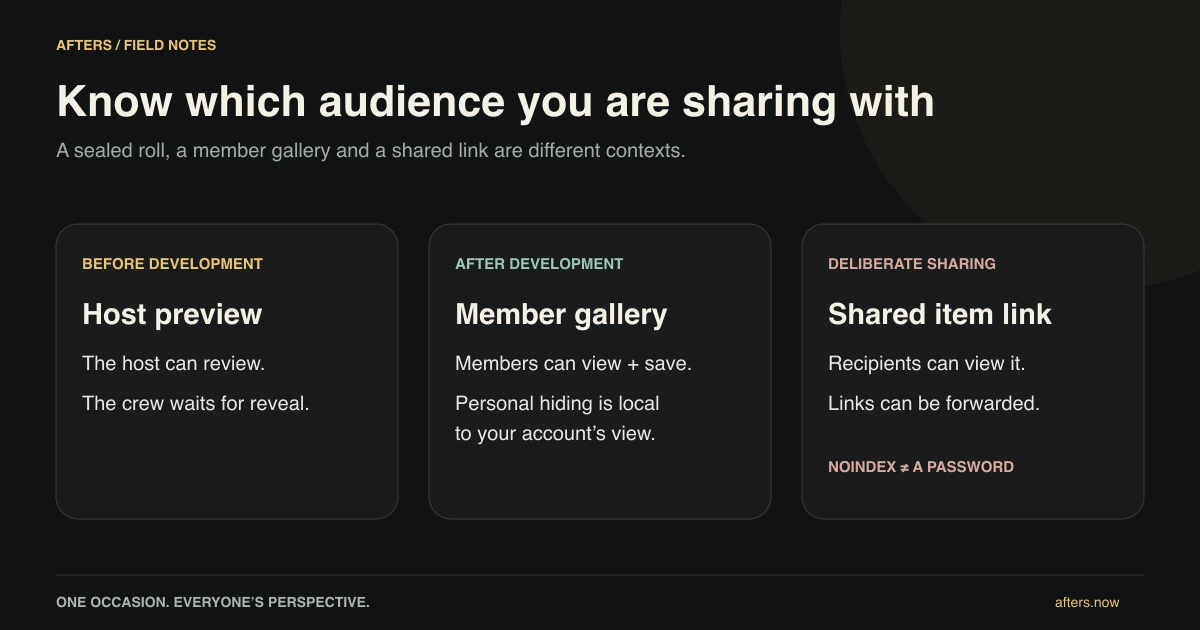
New rolls keep full photographs from the crew until development. The waiting screen may show a teaser, but it is not an open gallery. That shared pause is part of the experience: there is something to discover after the occasion, rather than a stream to follow during it.
The host can preview and moderate before reveal. Service-side processing and administration also exist, so sealed is not a promise of end-to-end encryption or that absolutely nobody can inspect a picture. Tell guests about the host's role. Honest expectations are more reassuring than a broad privacy claim that turns out to mean something narrower.
The album can be shared without every picture becoming public
Once the roll develops, its members can view the photographs, like them, comment and save individual favorites. That is the point of making a memory together. It also means somebody may have a copy on their own device; a later visibility change cannot pull every saved copy back.
Ask before taking a recognizable picture into a wider audience, especially around children, private spaces or a moment somebody found vulnerable. A person can love being in the group's memory and prefer not to appear elsewhere. A small conversation can preserve both the photograph and the trust that made it possible.
Sending a photo link opens another doorway
A deliberately shared developed-photo link lets its recipient view that item without joining the whole roll. It shows the item and associated context, not unrestricted access to every hidden picture. The recipient can still forward the link. A recap link similarly shares that recap and its context.
Shared-photo pages are not intended for search indexing, but noindex is not a password. Think about where you paste the link: a direct message to a friend is a different decision from a public post. If the photograph matters partly because it feels personal, take a moment to ask who else should be able to open it.
Know what changes when you hide a name or a picture
A host can choose whether photographer credits appear. That does not make comments, likes and mentions anonymous. Those remain identifiable social activity. It is fine to enjoy a playful roll, but nobody should be surprised by where their name still appears.
Personal hiding changes your own view; host moderation and reporting do different jobs. None removes copies already saved elsewhere. Current rolls do not expire automatically. If a picture worries you, use the relevant controls or contact support. The privacy policy and terms give formal information. The simple human rule remains: a shared memory is something to look after, not a permission slip to ignore someone's comfort.
Questions people ask
Can the host see photos before the roll develops?
Yes. The host can preview and moderate. Sealed means the ordinary crew waits for development, not that the host has no access to the pictures.
Can someone view a shared photo without joining the roll?
Yes, through a deliberately shared developed-photo link. It shows that item and its context, not the whole private roll. The link can be forwarded; noindex is not a password.
Does anonymous authorship hide my comments and likes?
No. That setting concerns photographer credits. Comments, likes and mentions remain identifiable. Personal hiding also changes only your view, not what others have saved or can see.
Keep reading
One house party, people you've just met, photos you can all keep
You can belong to the same evening without needing to become permanent friends.
How a shared disposable camera works: from first shot to reveal
Take a few pictures, come back to the party, and open the memory together afterward.
Your life in shared rolls: a personal photo history made together
Some people stay. Some evenings do not repeat. Both can have a place in your memories.