Weddings
How to get photos of the wedding after-party (after the photographer goes home)
By the Afters team · Updated · 5 min read
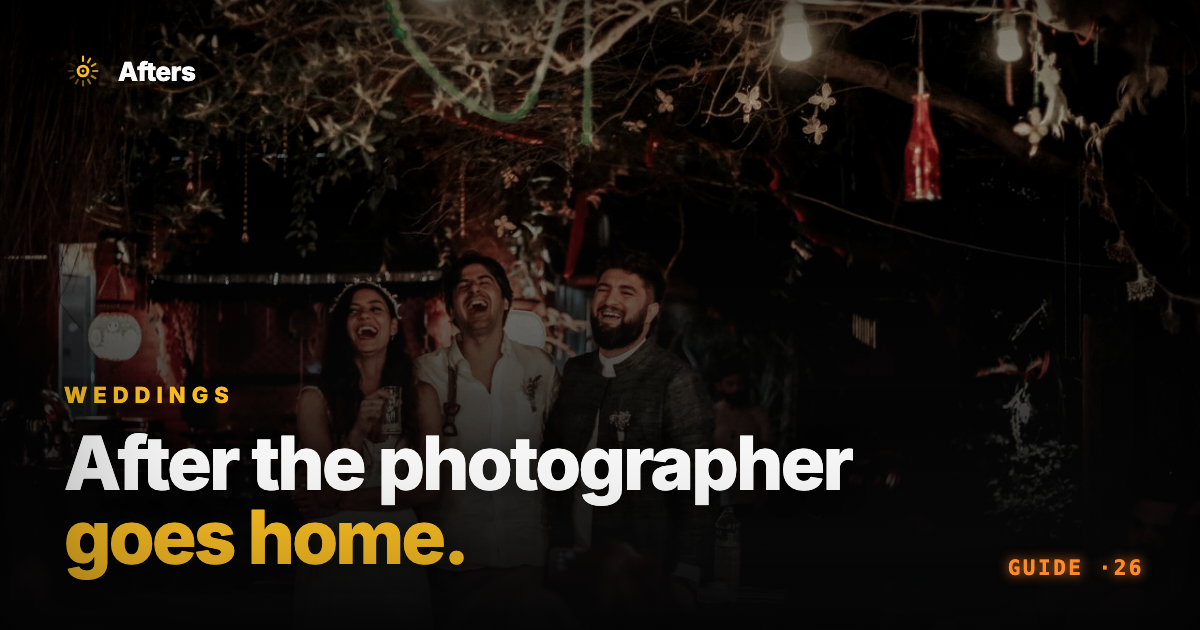
The standard wedding photography package is eight hours. For the ceremony and the bulk of the reception, that's enough. But weddings don't end when the photographer's contract does. The after-party, the late-night dance floor, the hotel bar at 2 a.m., the group still going at 3 — that's often where the most memorable moments actually happen.
And nobody documents it.
The missing hours
If your photographer arrives at noon for a 5 p.m. ceremony, their eight-hour coverage ends around 8 p.m. Most receptions run to 10 or 11. After-parties go later. The gap between "photographer leaves" and "last guest goes home" is often three to five hours of your wedding that exists only in people's memories — and maybe a few scattered phone photos nobody thought to collect.
Extending professional coverage is an option. Most photographers charge $200–400 per additional hour, which puts two extra hours at $400–800 more on top of an already expensive day. Most couples don't extend. Most also don't have a backup plan for what happens after the photographer leaves.
Why after-party photos are worth capturing
The reception has a structure: cocktail hour, dinner, speeches, first dance, cake cutting. Those moments are choreographed. The photographer knows they're coming and positions accordingly.
The after-party has no structure. It's the college friends who haven't been in the same room in four years finally catching up. It's your uncle proving he can still dance. It's the bride in sneakers because her feet gave up at hour six. It's the moment the whole wedding party piles into a photo at a dive bar at midnight.
These aren't moments you can plan. They're the ones that end up as your favorite stories.
What doesn't work
Hoping guests will send you photos later. They mean to. They don't. You'll get photos from whoever texted you within 48 hours. The rest sit on phones indefinitely.
Group chats or shared links sent after the fact. Same problem — these depend on follow-up behavior from people who just spent a long day at a wedding and are now recovering. The intent is there. The execution mostly isn't.
Keeping the photographer for the after-party. It works if the budget allows. But professional coverage of the after-party has a downside: people perform differently when there's a $5,000 camera in the room. Sometimes the most honest moments happen when nobody official is watching.
The simple handoff
The approach that actually works: a QR code left with your DJ or coordinator, with instructions to keep it active when the photographer leaves.
If you're running a guest camera roll during the reception, the same roll continues into the after-party. The coordinator makes a short announcement when the photographer wraps up: "The photographer's heading out for the night — the QR code on your tables is still live. Keep adding photos if you're staying." The shared roll doesn't stop collecting just because the professional coverage ends.
If you're starting the guest roll specifically for the after-party — at a different venue, or once the formal reception wraps — the DJ or whoever has a mic can announce it when the crowd moves: "There's a QR code at the bar tonight. Scan it and add your photos — the couple wants to see what happens after midnight."
The announcement is the key part. A QR code on a table or bar gets noticed by some people. An announcement in the room gets it to everyone at once.
What to tell guests about quality
After-party photos will look different from reception photos. Lower light, more motion blur, phones doing their best in conditions they weren't made for. That's fine. The standard here isn't "professional quality" — it's "proof that this happened."
It helps to say that out loud. "We're not looking for anything polished — just grab what you see" takes the pressure off. The grainy, slightly blurry shot of everyone at the bar at 1 a.m. is exactly what you'll want to look at in ten years. It doesn't need to be beautiful to be worth keeping.
The version that requires the least setup
Run a shared guest camera roll from the start of the reception and don't turn it off. Tell your coordinator it should stay active all night. If the crowd moves to an after-party venue, bring the QR code with you — print a few spares on your phone or take a screenshot.
One roll, one album, all night. The photos that come in after the photographer leaves are often the ones you'll look at most.
Questions people ask
How do I get photos of my wedding after-party when the photographer has gone?
Leave a QR card with the DJ or coordinator before the photographer departs. When the shared roll activates, guests who were at the main reception or joining for the after-party can scan and shoot immediately — no new setup.
How long does standard wedding photography coverage last?
Standard coverage is 8 hours (Zola/WeddingWire average). For a 5pm ceremony, the photographer typically finishes around 1am — well before most after-parties end.
Are wedding after-party photos worth capturing?
Often yes. Guards are down, formality is gone, and the moments are candid in ways that even good reception photography rarely captures. They're also typically the photos the couple's closest friends treasure most.
Keep reading
The coverage gap: what happens to the photos after your 8 hours end
The photographer leaves at 10. The night ends at 3. A handoff plan for the missing five hours.
How to collect wedding guest photos — without making anyone download an app
The complete, honest playbook: every method compared, what each really costs, and the one mistake that loses half your photos.
What is a shared party camera? How one roll for the whole crew works
The mechanics of the shared roll: caps, hidden-until-develop, the morning reveal — and why it changes the party.